
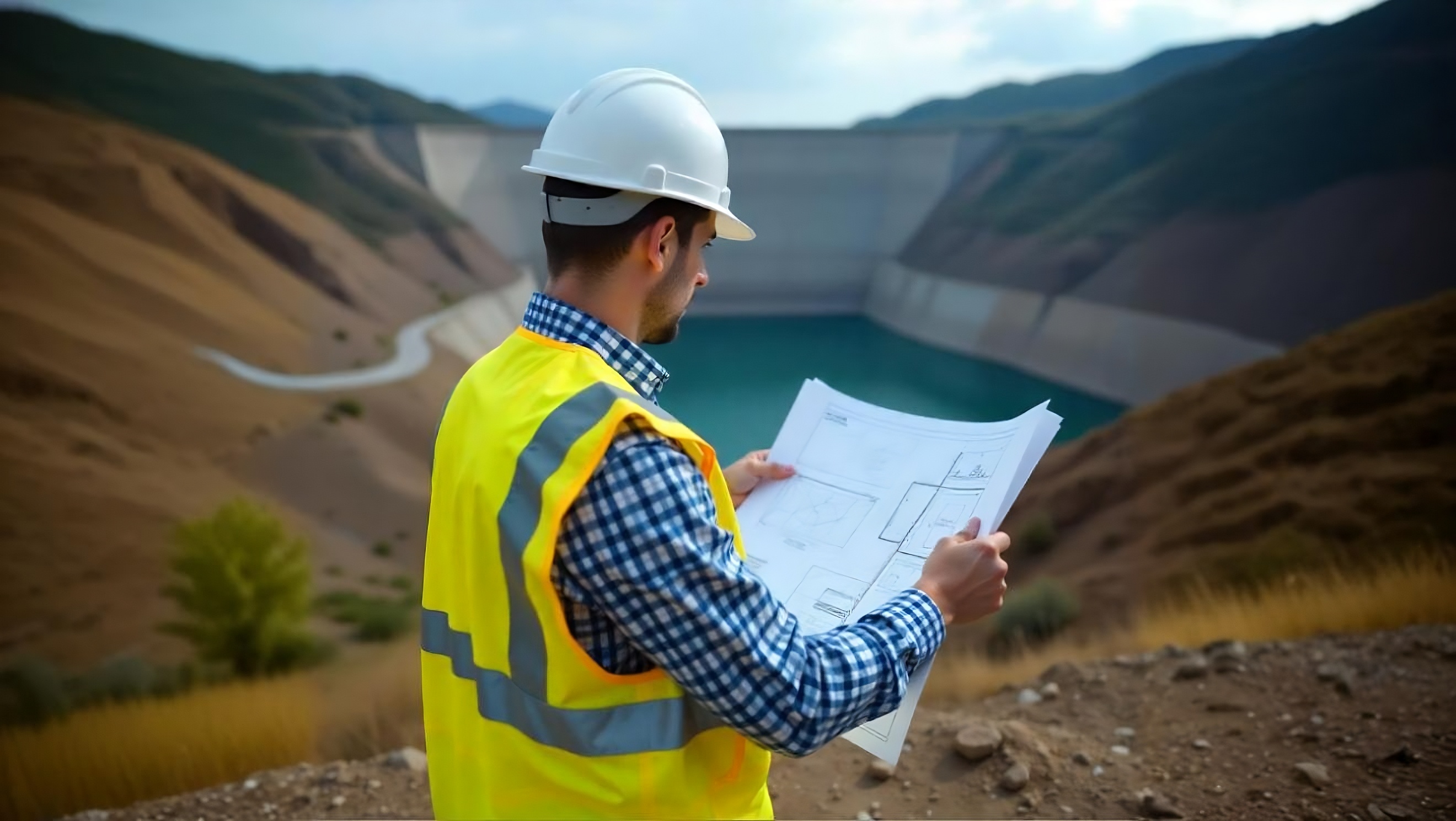
The Engineer of Record in the International Context: Guidelines, Responsibilities and Regulatory Perspectives

The increasing complexity of containment structures and the challenges associated with dam safety have driven the consolidation of a key role in technical governance practices: the Engineer of Record (EoR).
This figure is central to ensuring the continued technical responsibility on the performance and structural integrity of dams, assuming a critical role in risk management systems around the world.
General Duties of the Engineer of Record
While details vary depending on local laws and guidelines, there is a common core of responsibilities assigned to the EoR:
1. Comprehensive Technical Responsibility
From design, construction, alterations, operation and maintenance to the closure and decommissioning of the structure.
2. Continuity of Technical Knowledge
Maintenance of technical memory, as-built records, instrumentation data, geotechnical and hydrological analyses.
3. Technical Independence
The EoR must not be subordinated to productive or financial interests. Must have the freedom to report directly to senior leadership and the authority to stop unsafe operations.
4. Interface with Regulators
Acts as technical focal point between the enterprise and regulatory bodies, participating in the production of reports and critical decisions.
5. Risk Assessment
Leads the technical interpretations of risks, using tools such as probabilistic and deterministic analyses and uncertainty mitigation strategies.
International Comparison: How EoR is Recognized Around the World
Entity / Country
EoR Recognition
Full Life Cycle
Technical Independence
Technical Memory
Relationship with Regulators
Required Experience
Contractual Link
Legal Responsibility
ICOLD
Implicit in good practices
Recommended
Not explicit
Recommended
Indirect (guidance)
Not specified
Not defined
Not addressed
ICMM
Yes (required in GISTM)
Yes
Yes (direct access to leadership)
Yes
Yes
Yes (documented)
External and independent
Yes
CDA – Canada
Yes
Yes
Yes
Yes
Yes
Yes
Internal or external
Yes
ANCOLD – Australia
Yes (equivalent function)
Yes (in stages)
Yes
Yes
Yes
Yes
External or independent
Yes
USSD/FERC – USA
Yes (regulated via FERC)
Yes
Yes
Yes
Yes
Yes
External
Yes
ANM – Brazil
Yes (since 2019)
Yes
Yes (ANM Resolution No. 95/2022)
Yes
Yes
Yes (min. 5 years)
Internal or external
Yes
Main Regulatory References and International Practices
🇨🇦 CDA – Canadian Dam Association
Canada is a global reference on the subject. The EoR is formally established with assignments defined for all phases of the dam's useful life, including reporting directly to senior management.
🇦🇺 ANCOLD – Australian National Committee on Large Dams
Australia adopts a policy-based approach risk by phase, with the “Responsible Engineer” performing functions equivalent to the EoR. Technical traceability and professional independence are emphasized.
🇺🇸 USSD and FERC – United States
In the US, the role of EoR is consolidated under guidelines from FERC, especially in critical structures. It is required continuous supervision, record production and functional independence.
🌐 ICMM – International Council on Mining and Metals
After the Brumadinho disaster (2019), the ICMM instituted the EoR as mandatory figure for its members. The Global Industry Standard on Tailings Management (GISTM) imposes strict criteria of competence, independence and responsibility.
🇧🇷 ANM – National Mining Agency (Brazil)
In Brazil, the EoR (called Technical Responsible Engineer – ERT) was formalized with the ANM Resolution No. 13/2019, being reinforced by Resolution No. 95/2022, which requires technical independence, minimum experience and civil and criminal legal obligations.
The consolidation of the Engineer of Record (EoR) as a central technical agent in critical structures such as dams reflects a global trend to strengthen technical governance and risk management.
Despite the terminological and institutional differences, the converging principles include:
- Proven technical competence
- Functional independence
- Continuous and traceable accountability
- Direct communication with leadership and regulatory bodies
- Legal liability for omissions or failures
VinQ Geotechnics: Commitment to Technical Excellence and Responsibility
In the VinQ, we count on Registration Engineers with international experience, prepared to act from the initial studies to the closing of the structure, ensuring:
- Compliance with national and international standards
- Monitoring, stability and structural safety
- Risk-based technical governance and transparency
- Legal and ethical responsibility towards the environment and society
At VinQ, security is not a cost. It’s a value.
VinQ. Engineering with purpose. Solutions that transcend time.
 English
  Português do Brasil