

Rainy Season Plan: Preventive Management and Integrated Risk Management

In tropical and subtropical regions that encompass much of Brazil, climate variability is characterized by intense and concentrated precipitation patterns. In recent years, the intensification of extreme events has increased the exposure of mining structures, such as pits, waste rock and tailings dumps, and dams, to hydrological, hydraulic, and geotechnical risks.
In this context, the Rainy Season Plan (PPC) It has established itself as one of the main preventive engineering tools. In addition to preparing for rainy seasons, it organizes action plans that include special inspections, maintenance protocols, and emergency responses.
More than meeting regulatory requirements, the PPC incorporates the logic of Risk-Informed Decision Making (RIDM), basing decisions on risk analyses that integrate operational, environmental and social aspects.
As highlighted in ICOLD guidelines and GISTM, the management of rainy periods must be integrated into the life cycle of geotechnical structures, reinforcing that water control and drainage are not episodic measures, but continuous practices that extend from design to closure.
Plan in practice: Structural specifics
The effectiveness of the PPC does not derive from its mere formalization, but from its ability to adapt to the characteristics of each structure. It is not a generic model, but a plan adjusted to local geological, hydrological, and operational conditions.
Structures and vulnerabilities
- Cavas: susceptible to flooding of the pit bottom and erosion during heavy rains. The PPC should prioritize pumping redundancy, efficient drainage, and protection of downspouts.
- Waste and tailings piles: more vulnerable to localized saturation and fines carryover. The PPC needs to strengthen surge monitoring, channel and dissipator maintenance, and critical slope reconfiguration.
- Tailings dams: as essentially hydraulic structures, they require specific protocols for spillways, filters and drains, including redundancy in overflow channels and immediate response plans.
Therefore, it is clear that the PPC is, above all, a tailor-made methodological instrument, adjusted to the specific vulnerabilities of each typology.
Prevention and control of anomalies
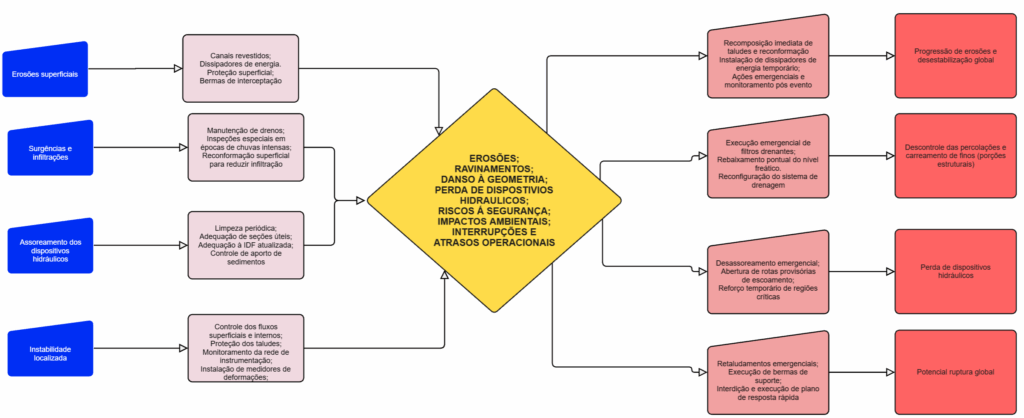
Many of the anomalies observed during rainy periods result from drainage and maintenance failures. The PPC organizes the prevention and mitigation of these occurrences through control barriers structured according to the logic Bow Tie.
This systematization allows potential failures to be transformed into a visual map of integrated risk management, reinforcing the practical nature of the PPC.
Hydrological management and regulatory integration
Another pillar of the PPC is the continuous updating of hydrological studies. Reliance on outdated historical data is a critical failure factor, as recognized by ICOLD and CDA.
The PPC must adopt a logic of Adaptive Management, reassessing precipitation scenarios through:
- Periodic review of IDF (Intensity–Duration–Frequency) curves;
- Updating project hydrographs;
- Incorporation of hydrometeorological forecast models (forecasting) for operational support.
In Brazil, the PPC is based on current legislation, being used as good practice by instruments such as the ANM Resolution 95/2022, ABNT NBR 13028 and 13029/2024 and state guides, such as those from FEAM/MG.
At the international level, its logic is aligned with GISTM Principle 7, which requires operational preparation for critical environmental scenarios.
THE Rainy Season Plan (PPC) It has established itself as a highly important element in integrated risk management, whose function goes beyond developing seasonal plans. It represents the connection between updated hydrological data, field inspections, risk analysis, and informed decision-making.
By adopting risk mitigation methodologies such as PDCA, Bow-Tie and Risk-Informed Decision Making (RIDM), according to ICOLD, GISTM, CDA and ANCOLD, the plan ceases to be just a regulatory obligation and becomes a strategic mechanism.
When combined with robust drainage systems, the PPC becomes a operational shield, capable of preventing the escalation of anomalies and strengthening the resilience of operations even under extreme rainfall events.
In the VinQ Geotechnics, we adopt this approach by integrating conceptual frameworks and aligning each PPC with the lifecycle and particularities of each structure. In this way, we treat the plan not only as a regulatory requirement, but as a strategic preventive engineering instrument, which ensures safety, sustainability and compliance with standards comparable to international best practices.
Authors:

John Paul dos Santos
Bachelor in Mining Engineering (UFMG), Master in Civil Engineering and Management (University of Glasgow), Specialist in Geotechnical Engineering and Project Management.
Mining Engineer specializing in geotechnics and project management, an international reference in dams and geotechnical structures applied to mining.

Matheus Vicentini
Civil Engineer (Unilavras), Specialist in Geotechnical Engineering (PUC Minas).
Civil Engineer with experience in geotechnics applied to mining, with experience in projects, audits and dam decommissioning works.
 English
  Português do Brasil