Skip links

Introduction to the Classification of Rock Masses

The characterization of rock masses is a fundamental step in the development of geotechnical projects in environments where the rock is exposed or near the surface. Proper assessment allows us to understand the structural behavior of the terrain, define excavation criteria, and design support and containment systems with technical and economic safety. To this end, several geomechanical classification systems have been developed over the decades, the most established in engineering practice being RMR, Q-System, and GSI.

Originating from the need to objectively describe the geotechnical attributes of the massif, the classification of rock masses uses subjective attributes transformed into objective criteria.

The classification has six objectives that aim to provide an objective description of the rock mass, based on aspects relevant to geotechnical applications.

Since Ritter's initial proposal in 1879, empirical systems such as RMR, Q, and GSI have evolved and become popular based on real-world engineering cases, as described by WOLPP (2018). These methods, composed of multiple parameters, including strength, weathering, fractures, discontinuity orientation, and water conditions, are frequently used in the design of underground structures and open-pit mines for proper sizing.

But in general, the systems evaluate several aspects, such as:

  • Strength of intact rock;
  • Characteristics of discontinuities (spacing, orientation, surface, filling, permeability);
  • Presence of groundwater and hydrogeological conditions; and,
  • Stress state in the massif.

Based on this classification, it is possible to construct a three-dimensional model that integrates geological, structural and geomechanical data, thus enabling the simulation of excavation scenarios, project optimization and risk mitigation throughout the life of the project or mine in question.

Therefore, based on this introduction, we present below the most widely applied methodologies currently:


RMR – Rock Mass Rating (Bieniawski, 1973)

The RMR aims to provide a numerical classification of the rock mass based on six parameters that influence its quality:

  • Intact rock strength (UCS)
  • RQD (Rock Quality Designation)
  • Spacing of discontinuities
  • Condition of discontinuities (persistence, roughness, filling, etc.)
  • Groundwater conditioning
  • Orientation of discontinuities (adjusted as correction factor)

This classification has a variation range from 0 to 100, being The higher the value, the better the quality of the massif. Thus, the massifs are classified according to the following classes:

Class

Range

Description

I

81 – 100

Very good

II

61 – 80

Good

III

41 – 60

Regular

IV

21 – 40

Bad

V

40

Very good to excellent

Additionally, RMR is widely used in:

  • Support sizing in tunnels
  • Estimation of bearing capacity of foundations
  • Stability of rock slopes

Q-System (Barton et al., 1974)

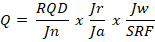
Barton's Q system aims to quantitatively describe the quality of the rock mass, focusing on tunnel stability and support design. The Q system is determined by a mathematical equation that evaluates the combination of the following aspects:

  • RQD = Rock Quality Designation
  • Jn = Number of sets of discontinuities
  • Jr = Roughness of discontinuities
  • Ja = Change in the surfaces of discontinuities
  • Jw = Water condition
  • SRF = Resistance Reduction Factor

Being determined by:

This classification has a variation range of 0.001 to 1000 with the following classes as characteristics:

< 0.1

Extremely bad

0.1 – 1

Very bad

1 – 4

Very bad

4 – 10

Regular

10 – 40

Good

> 40

Very good to excellent

GSI – Geological Strength Index (Hoek & Brown, 1994 and revised in 2002)

The GSI aims to provide an estimate of the strength of the rock mass (as a whole, not just the intact rock), to be used primarily with the Hoek-Brown criterion. To this end, it considers the following parameters:

  • Structural aspect of the massif (intact, laminated, fractured massif, etc.)
  • Surface condition of discontinuities (degree of weathering, roughness, filling)

The methodology is based on visual observation and the use of geomechanical maps, facilitating its application in the field, with a variation range from 0 to 100, where GSI > 75 implies a very good massif and GSI < 25 means an extremely weak massif.

Routine applications of this methodology include:

  • Parameter estimation for numerical modeling (cohesion, friction, deformation modulus);
  • Stability analysis (slopes and tunnels); and,
  • Input for the generalized Hoek-Brown strength criterion.

As a comparative measure, the table below summarizes the main factors of each methodology addressed.

SYSTEM

APPROACH

MAIN FOCUS

DEGREE OF SUBJECTIVITY

MAIN APPLICATION

RMR

Empirical / Numerical

Support and stability

Moderate

Tunnels, slopes, foundations

Q

Empirical / Numerical

Tunnel stability

Moderate/High

Tunnels (support)

GSI

Visual / Semiempirical

Massif resistance

High

Numerical modeling, slopes

The correct selection and application of the most appropriate classification system depends on the study objective, the type of project, and the level of knowledge of the rock mass. In practice, the combination of RMR, Q, and GSI methods allows for more robust diagnoses, aiding technical decision-making and geotechnical risk management throughout the project lifecycle.

At VinQ, we use these systems in an integrated manner within the geological, structural, and hydrogeotechnical context of each project, ensuring analyses that are compatible with field reality and applicable regulatory requirements.

  • In mining projects, the classification helps in defining stable pit and waste pile geometries.
  • In civil works, allows you to estimate the load capacity of foundations and design efficient retaining walls.
  • In underground infrastructure, such as tunnels, defines the need and type of support, increasing the predictability and safety of the project.

Authors:

John Paul dos Santos

Bachelor in Mining Engineering (UFMG), Master in Civil Engineering and Management (University of Glasgow), Specialist in Geotechnical Engineering and Project Management.

Mining Engineer specializing in geotechnics and project management, an international reference in dams and geotechnical structures applied to mining.

Leandro Azevedo da Silva

Bachelor in Geology (UFRRJ), Master in Mining Engineering (UFMG) and Specialist in Mineral Resources Engineering.

A geologist with nearly 20 years of experience in geotechnics, he leads technical projects at VINQ, combining innovation and safety in mining solutions.

Leave a comment

🍪 Our website uses cookies to improve your browsing experience
en_USEnglish