
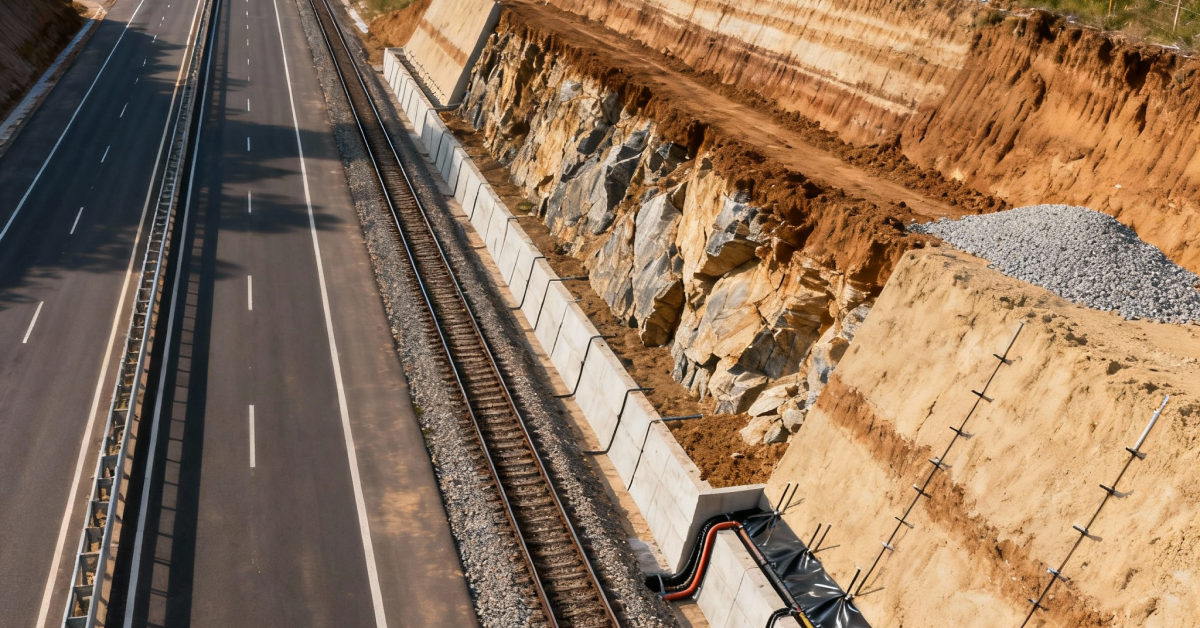
Resilience in Linear Infrastructures: An Integrated Approach to Risk, Safety and Sustainability

Resilience is the ability of an individual, organization, or system to absorb impacts, adapt to change, and recover from adversity without losing its essential functions. More than just resistance, it's about transforming challenges into opportunities for learning and strengthening.
In this context, resilience applied to linear infrastructure works It has ceased to be a competitive differentiator and has become an essential requirement for safety, operational continuity and long-term sustainability.
Infrastructures such as highways, railways, pipelines, and transmission lines are critical elements of production and logistics chains, sustaining entire economies and ensuring the connectivity of territories. When weakened, the impacts of their disruption result not only in immediate financial losses but also in significant social, environmental, and reputational losses.
An integrated approach to resilience
Unlike a restricted approach to structural safety, resilience requires a comprehensive vision that combines:
- Technical analysis and risk management;
- Technological innovation;
- Corporate governance.
This integration allows the infrastructure to remain functional and secure in the face of uncertainty, ensuring the sustainability of the investment and preserving the trust of communities, investors, and regulatory bodies.
Practical application of resilience
The practical application of resilience begins in the design phase. Robust projects consider geotechnical, environmental, hydrological, and climatic variables from the outset. Furthermore, they incorporate probabilistic and multi-criteria analyses that balance technical feasibility, environmental impact, and operational safety.
In construction, resilience manifests itself through adaptive construction practices and continuous monitoring. In operation, it becomes a living management process, supported by geotechnical instrumentation, remote sensing and intelligent warning systems.
In the long term, resilience also encompasses adaptive capacity, enabling linear infrastructures to respond to changing demands, regulatory shifts, and the effects of climate change.
Resilience application cases
Some examples illustrate how this concept is already applied in different contexts:
International and national examples:
PROJECT / LOCATION
TYPE OF INFRASTRUCTURE
RISK CONTEXT
RESILIENCE SOLUTION
KEY LEARNINGS
Shinkansen (Japan)
High-speed railway
High seismicity, tsunamis and heavy rains
Redundant seismic monitoring systems, automatic shutdown and adapted foundations
Integration between advanced geotechnical engineering and immediate operational response ensures safety without compromising efficiency
Channel Tunnel
Underwater railway tunnel
Complex geology (limestone, chalk, tectonic faults) and water pressure
Continuous adjustments to construction methods, segmented coatings and redundancy in ventilation and drainage
Real-time adaptability during execution is a critical factor for structural robustness
Crossrail (London, United Kingdom)
Metropolitan rail network
Growth in urban demand, interaction with ancient structures
Designed with capacity margins, electrical redundancy and intelligent monitoring systems
Modular design ensures longevity and flexibility for future expansion
BR-163 (Brazil – Amazon)
Strategic highway for agricultural exports
Intense rainfall, saturable and erosive soils
Adapted paving, reinforced drainage and predictive maintenance based on remote monitoring
Continuous and preventive maintenance is essential in tropical environments with high climate variability
Vale's railway network (Brazil)
Logistics railway for iron ore
Unstable slopes, extreme rainfall and remote sections
Geotechnical instrumentation, aerial drone inspections, and rapid response protocols
Digital technology accelerates risk detection and reduces disruption costs
Tucuruí Power Line (Brazil – North)
Electrical transmission line
Crossing difficult-to-access and high-humidity areas
Metal structures adapted to marshy soils and deep rockfill foundations
Adaptation to the physical environment increases reliability in critical regions
Strategic insights into resilience
Comparative analysis of the projects highlights fundamental lessons:
- Integration between design and operation: Assets designed to incorporate intelligent monitoring and rapid response achieve greater reliability.
- Adaptation as a competitive advantage: Infrastructures that adapt to climate and geotechnical changes reduce life cycle costs and extend longevity.
- Digitalization as a pillar: The use of BIM, digital twins, IoT, and remote sensing strengthens risk management with predictive diagnostics and data-driven decisions.
- International benchmarking: Japan and Europe exemplify excellence in redundancy and modularity, while Brazil contributes valuable experience in adapting to tropical conditions.
For the VinQ Geotechnics, resilience is not just a technical concept, but an integrated management philosophy. By combining methodological rigor, technological innovation, and strategic vision, we support clients in the design, implementation, and operation of linear infrastructures that not only meet immediate demands but also remain safe, efficient, and sustainable in the face of future uncertainties.
Authors:

John Paul dos Santos
Bachelor in Mining Engineering (UFMG), Master in Civil Engineering and Management (University of Glasgow), Specialist in Geotechnical Engineering and Project Management.
Mining Engineer specializing in geotechnics and project management, an international reference in dams and geotechnical structures applied to mining.

Leandro Azevedo da Silva
Bachelor in Geology (UFRRJ), Master in Mining Engineering (UFMG) and Specialist in Mineral Resources Engineering.
A geologist with nearly 20 years of experience in geotechnics, he leads technical projects at VINQ, combining innovation and safety in mining solutions.
 English
  Português do Brasil