
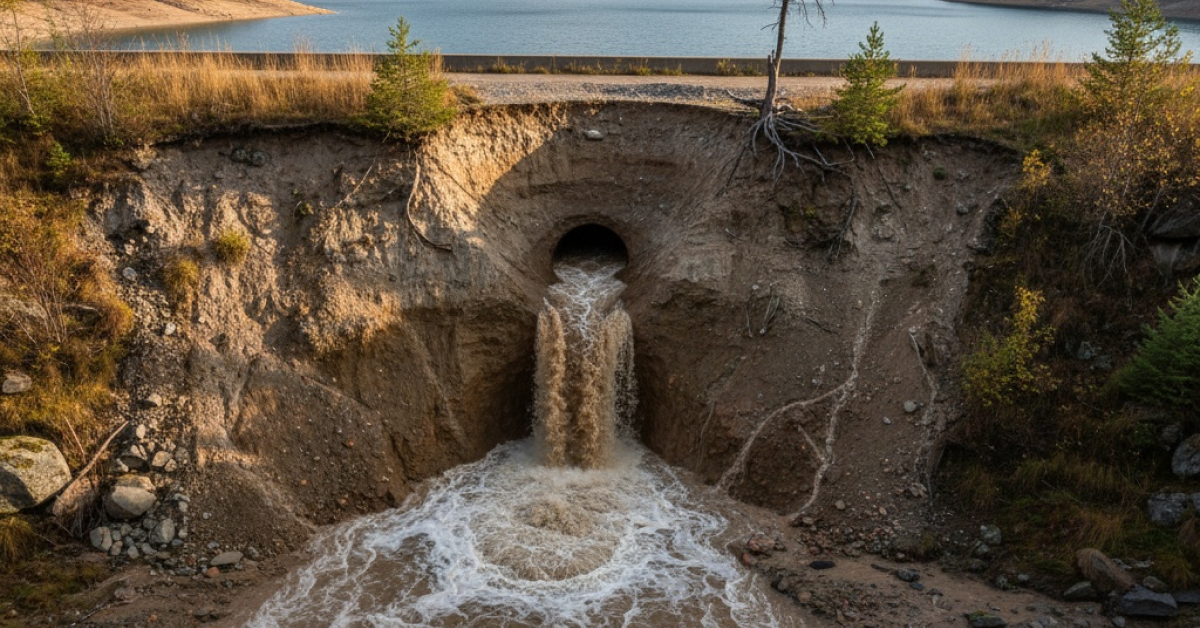
Piping in Dams: Between Modeling of Rupture Studies and Geotechnical Mechanisms

The hypothetical rupture study by piping in dams aims to conservatively evaluate the possible effects of a failure resulting from this mechanism, even if the probability of its actual occurrence is considered low. For this type of analysis, it is common to use simplifications, such as the adoption of parameterized hydrographs or the representation of a idealized loophole, without the internal processes of initiation and evolution of erosion being modeled in detail.
Relationship Between Scenarios and Piping Geotechnics
When a correlation is established between such scenarios and the geotechnics of piping, it is noted that the initiation and propagation of internal erosion follow well-known mechanisms for different soil types, serving as a basis for giving greater consistency to hypothetical rupture studies.
Initiation of the process
In geotechnical terms, the start of piping is directly related to the balance between the mobilized hydraulic force, expressed by the hydraulic gradient, and the soil resistance to erosion. The EUROCODE 7, the classical criterion of Terzaghi for critical gradient and the experiments of Hanson & Simon (2001) indicate that piping starts when the hydraulic shear stress (τ) surpasses the critical shear stress (τc) of the material.
This behavior varies depending on the type of soil: in sands and silts, progressive transport of particles occurs; already in cohesive soils, initiation is slower due to greater resistance, but once triggered, the process evolves rapidly with the transport of fines and increasing hydraulic gradients.
Development of Piping in Dams
Applied to the context of earth or rockfill dams, piping can be developed in critical zones, such as contacts between the massif and foundation, poorly compacted interfaces, or regions where fine materials are interstitially present.
Once initiated, the concentrated flow removes fine particles and tends to gradually widen the erosion path until it forms continuous trajectories. This mechanism, documented in geotechnical literature, is generally described in three stages:
- Initiation – moment when particle displacement begins.
- Progressive erosion – intensification of transport and lengthening of the erosion path.
- Formation of unstable galleries – critical phase that could culminate in structural collapse.
In hypothetical rupture studies, however, this sequence is rarely represented. Piping progression is assumed to be a final state of a breach formed in shorter timescales than the physical ones, thus ensuring a conservative assessment of downstream impacts. This methodological difference is deliberate: while geotechnics seeks to understand the mechanisms and estimate the probability of occurrence, the Dam Break studies focus on the consequences of the rupture, without detailing the internal erosion.
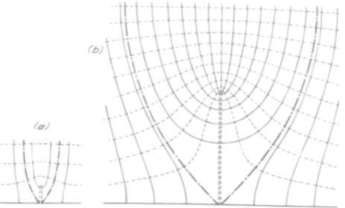
Connection Between Geotechnics and Rupture Studies
Despite the methodological simplification, the connection between the two fields is clear. Geotechnics provides critical parameters that allow for the calibration of more realistic and defensible scenarios, such as:
- Critical shear stress (τc);
- Erodibility index (Kh);
- Critical gradient.
Furthermore, the knowledge that compacted rockfill, interlocking blocks and granular filters hinder the progression of erosion and can support the construction of alternative scenarios of lesser severity and more faithfully reflect the reality of the structure.
Particularities in Rockfill Dams
This aspect takes on special importance in the case of rockfill dams. Hypothetical failure studies typically simplify the representation of the phenomenon, failing to adequately reflect the physical constraints, leading to an imbalance between the protection of downstream communities and technical rationality (ICOLD, CDA, FERC, FEMA, ANM, and HSE-UK).
Even if the progression of piping causes localized settlements or partial collapses of the rockfill, the relocation of the blocks tends to increase the tortuosity of the flow and the modify the preferred percolation trajectoriesThese effects reduce the speed of water within the massif and require more intense hydraulic forces to maintain the continuity of erosion until complete rupture.
Furthermore, in rockfill dams, the internal heterogeneity, the high porosity and the coarse grain size introduce particularities that are not well captured by current models (Dezert et al., 2024; Sigurjónsson, 2020). Thus, the uncertainty associated with parameters such as erodibility, configuration, and construction methods limits the accurate representation of the breach evolution process when compared to classical hypothetical dam failure methodologies, constituting a barrier to be overcome in the coming years.
While geotechnical analysis focuses on the physical aspects of piping initiation and evolution, the hypothetical rupture study seeks to answer the essential question: What would be the consequences if the failure actually occurred?
The integration of these approaches strengthens technical robustness, as it allows simulations to not only comply with standards and guidelines, but also be anchored in plausible physical mechanisms of internal erosion.
Authors:

John Paul dos Santos
Bachelor in Mining Engineering (UFMG), Master in Civil Engineering and Management (University of Glasgow), Specialist in Geotechnical Engineering and Project Management.
Mining Engineer specializing in geotechnics and project management, an international reference in dams and geotechnical structures applied to mining.

Matheus Vicentini
Civil Engineer (Unilavras), Specialist in Geotechnical Engineering (PUC Minas).
Civil Engineer with experience in geotechnics applied to mining, with experience in projects, audits and dam decommissioning works.
 English
  Português do Brasil