
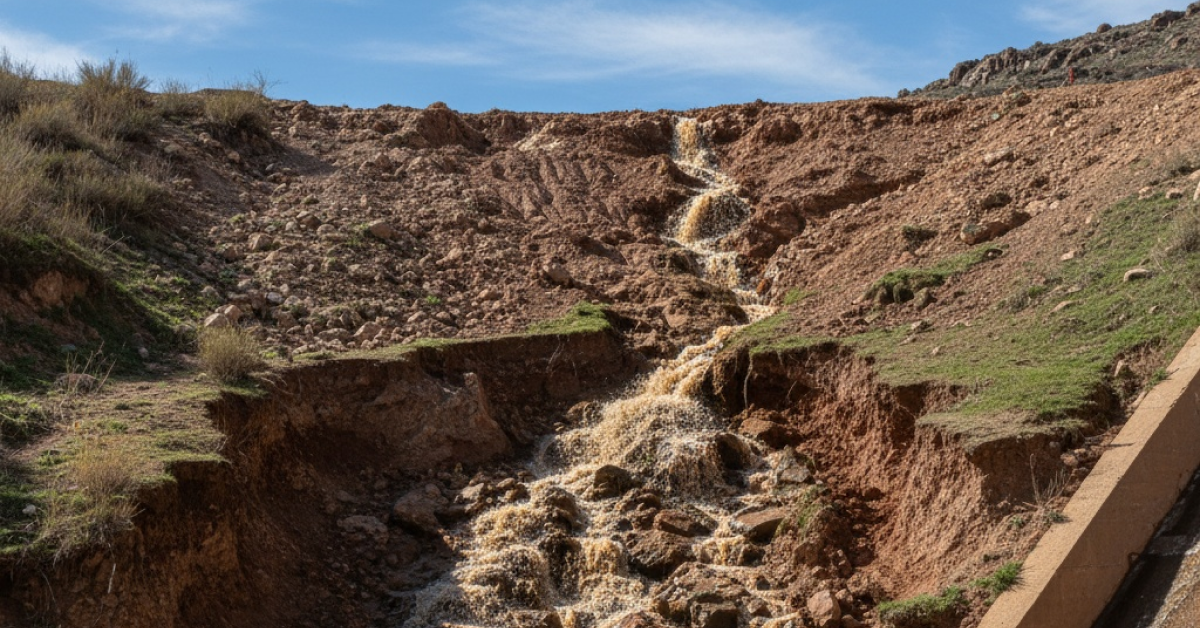
Influence of Rockfill Erodibility on Breccia Formation

THE training time and the gap geometry are crucial factors in studies of hypothetical dam rupture, as they directly influence the volume mobilized and the rupture hydrograph.
For the analysis, two main models were adopted: Froehlich (2016), aimed at defining geometric and temporal parameters in cases of instability, and the massif erodibility method proposed by Meng (2025), applied to situations of overtopping or internal erosion. In the latter, the formation time and depth of the breach are conditioned by the erosion resistance of the material.
Application of Meng's Methodology (2025)
In the simulated scenarios for the main massif, Meng's (2025) methodology was used to evaluate the breach opening, assigning to the erodibility index (Kh) fundamental role in determining erosive progression.
However, the study does not present Kh parameters specifically applicable to rockfill. This limitation compromises the applicability of the method in this region of the massif, since rockfill structures have significantly higher resistance to hydraulic drag. This is due to the greater weight of the blocks, natural interlocking and to the spreading material with a bulldozer during construction, which generated greater embedding of the blocks.
Technical literature describes that, in rockfill composed of large, interlocking blocks, there is a combination of high critical drag stress (τcr) with high erodibility index (Kh). In this way, the breach takes time to form, but once it does, it can evolve if there is enough force to destabilize the constructed matrix.
Importance of Defining Erodibility Parameters
The correct definition of erodibility parameters is essential, as it directly impacts the gap opening time and in their final dimensions. Therefore, it is recommended to use methodologies that consider criteria of hydraulics of riprap-lined canals, evaluating the physical possibility of mobilizing this material.
In this context, simple and complementary methodologies are suggested that compare the hydraulic stress available in the gap with the rockfill resistance. Among the applicable calculations, the following stand out:
- Background shear stress equation (Simplified Shields), which evaluates mobilization based on the relationship between the acting tension (τb) and the critical tension for drag (τcr);
- Critical drag velocity (Vcr) equation, which allows checking stability against the peak velocities simulated in the hydrograph.
If the calculated hydraulic stress is less than the critical stress, or if the peak velocity is less than the critical velocity, it is concluded that the rockfill remains stable.
Gap Depth and Normative Considerations
Another relevant aspect is the gap depth. It should not be automatically assumed that the failure will progress to the foundation of the structure, especially in dams reinforced by rockfill and filters that act as barriers to erosion.
Even if the ABNT NBR 17.188 (2024) clearly determine that the "final breach height should be considered as the greatest difference between the crest of the structure and the flow control section during breach opening," it is essential to evaluate the physics of the movement and the real possibility of such mobilization occurring. This approach brings the model closer to reality, favoring protection of lives in a more direct and consistent way.
The riprap on the downstream face plays a role in armor, keeping larger blocks stable even when fine particles are removed. This behavior justifies limiting the breach depth above the foundation, which results in a lower mobilized volume, a change in the rupture hydrograph, and a reduction in peak flow.
Complementary Methodologies for Gap Calibration
Based on these concepts, it is suggested that complementary analysis methodologies be used to the traditional study of hypothetical rupture to calibrate the gap parameters.
Among the applicable criteria, the following stand out:
- Shields, to evaluate the mobilization of blocks as a function of shear stress.
- Isbash, to check the stability of blocks at critical speeds.
Other criteria may be applied at the designer's discretion. If it is concluded that mobilization is limited, the resulting scenario will be characterized by a shallower gap, longer training time and peak flow reduction. This leads to a minor flood spot and technically defensible, supported by verifiable physical criteria, as recommended in ABNT NBR 17.188 (2024) and documented as a credible scenario.
The influence of rockfill erodibility in breach formation is crucial for hypothetical rupture studies. Correctly defining parameters, combined with complementary analysis methodologies, allows for greater alignment with physical reality, resulting in more consistent, technically defensible models that comply with current regulations.
Authors:

John Paul dos Santos
Bachelor in Mining Engineering (UFMG), Master in Civil Engineering and Management (University of Glasgow), Specialist in Geotechnical Engineering and Project Management.
Mining Engineer specializing in geotechnics and project management, an international reference in dams and geotechnical structures applied to mining.

Leandro Azevedo da Silva
Bachelor in Geology (UFRRJ), Master in Mining Engineering (UFMG) and Specialist in Mineral Resources Engineering.
A geologist with nearly 20 years of experience in geotechnics, he leads technical projects at VINQ, combining innovation and safety in mining solutions.
 English
  Português do Brasil