
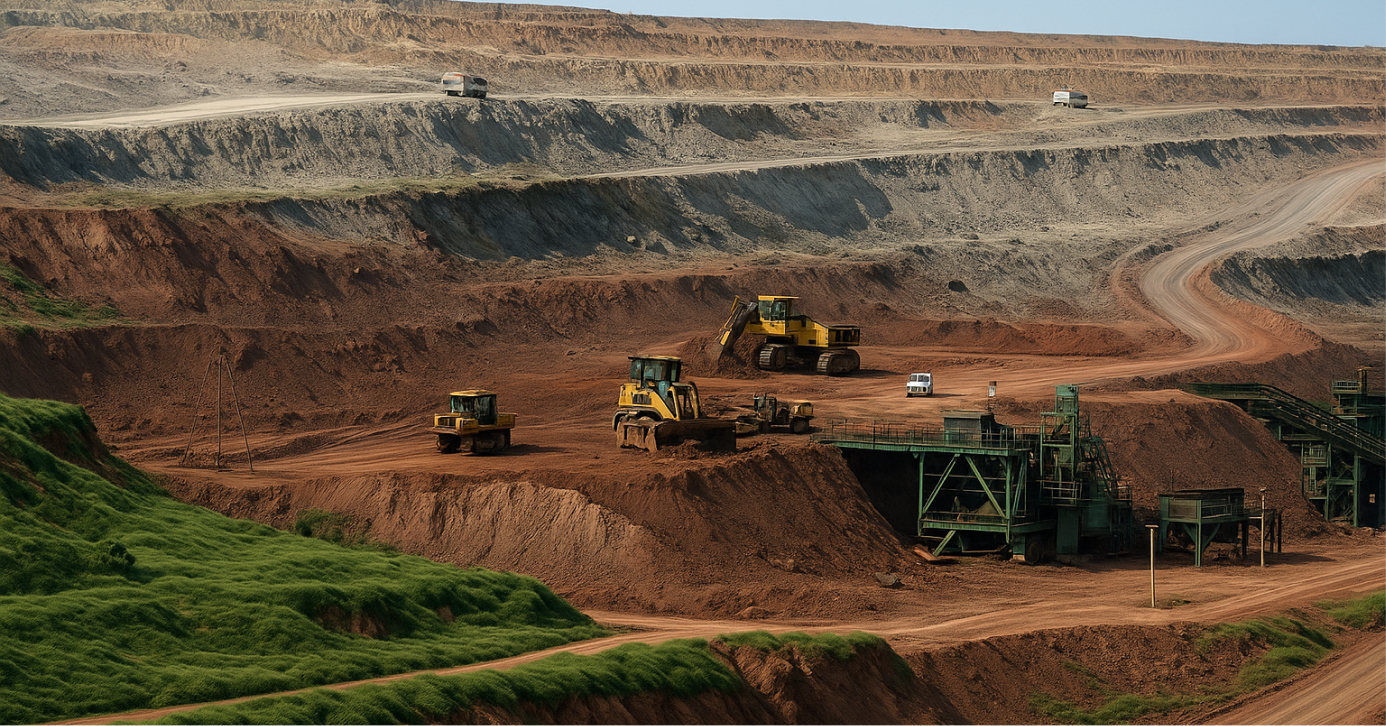
Liquefaction in Co-disposal Piles: The Grey Zone Between Waste and Waste Piles and TSF

The global dam safety agenda has shifted the industry's focus to TSFs (Technical Safety Standards), risk management protocols, and regulatory compliance. In parallel, without the same visibility, a significant portion of geotechnical risk has migrated elsewhere: tailings piles with high fines content, piles built on complex materials, and co-disposal arrangements where tailings and waste rock share the same embankment structure.
These hybrid structures occupy a gray area between the classic archetype of “draining sterile pile” and the one of “saturated tailings dam"In most records, they are still registered as piles, but from the point of view of soil mechanics and hydrogeology, many of them operate as partially saturated granular reservoirs, with internal portions susceptible to static liquefaction and flow behavior in case of rupture."
Recognizing, characterizing, and managing this gray area is currently one of the most relevant blind spots in mining risk governance. This article delves into the physical mechanisms involved, the limitations of traditional stockpile models, a technical framework for assessing liquefaction in hybrid structures, and the implications for corporate governance.
Dam reduction, increased use of hybrid structures: the silent displacement of risk.
The combination of regulatory pressure, investor expectations, ESG commitments, and the memory of catastrophic failures has led the industry to reduce its reliance on large conventional dams. In response, solutions such as filtered tailings, co-disposal piles, and other similar solutions have proliferated. backfill In pits, piles with a higher proportion of fines, complex reshaping, and arrangements in which tailings and waste rock are treated as a single operational volume.
In theory, these approaches promise clear gains. They reduce the volume of stored water, decrease flooded areas, potentially mitigate acid drainage, and streamline the portfolio of structures. In practice, however, much of these solutions are implemented based on assumptions inherited from the design of waste rock piles, without a thorough review of the resulting behavior when fines, high saturation, and complex drainage enter the equation.
The aggregate effect is a shift in the risk of liquefaction. The number of dams classified as TSF (Transfer of Saturated Tailings) may decrease, but the number of structures containing volumes with saturated tailings behavior, although registered as stockpiles, increases. If governance does not keep pace with this movement, the organization begins to operate with a perception of risk lower than the physical reality.
The gray area: a continuum of behavior between stack and TSF
In practice, there is no rigid boundary between a "waste pile" and a "tailings dam." There is a continuum of behavior controlled by a set of physical and operational variables. Among these variables, the following stand out: the fines content and its distribution, the degree of saturation and hydraulic connectivity, the relative density and the history of effective stresses, the deposition and segregation mechanism, the raising pattern and the level of lateral confinement, as well as the interaction with the foundation and adjacent structures.
As the design and operation push these parameters toward regimes of high fines content, high saturation, low relative density, inefficient drainage, and aggressive loading cycles, the overall behavior of the structure approaches that of a tailings pile, even though it continues to be called a stockpile. In co-disposal, this is especially evident: coarse waste and fine tailings, when mixed heterogeneously, tend to form internal volumes with their own hydraulic and mechanical signatures, different from the average envelope used in simplified analyses.
The gray area emerges precisely when cadastral classification and risk perception remain within the "stack" universe, while actual behavior, especially in extreme scenarios, shifts towards the "TSF" universe.
Liquefaction mechanisms in co-disposal stacks
The basic mechanisms of static and cyclically induced liquefaction are well known in the tailings literature. What changes in hybrid structures is the context: high heterogeneity, complex geometries, unintuitive hydraulic regimes, and strong dependence on the stress path throughout the service life.
A first critical mechanism is the contractile behavior of saturated fine matrices. Layers, lenses, or pockets of silty-sandy or fine sandy material, arranged with low relative density and maintained close to saturation, tend to exhibit a strong tendency to shrink under undrained loading. In terms of critical state, the material operates with a high state index, positioned above the critical state line, which means that small increments of stress, without drainage, can push it towards a trajectory of increasing pore pressure, reducing effective stress, and collapsing undrained strength.
A second mechanism is the accumulation of pore pressures in confined zones. Interfaces between coarse blocks and fine matrices, contacts with low-permeability facies, or abrupt transitions in hydraulic conductivity create pore pressure "traps." Under successive uplifts, extreme rainfall recharge, or groundwater level rises, these zones cannot rapidly dissipate water under excess pressure, leading to effective stress states much lower than those assumed in simplified models.
A third point is the slow transition from unsaturated to saturated regimes over time. Projects that assumed significant matric suction, providing additional resistance due to apparent stress effects, may see this margin disappear as drainage systems degrade, drains become clogged, maintenance routines fail, or the climate becomes more extreme and concentrated. Areas that were previously partially dry begin to operate at high saturation, with a significant reduction in mobilizable resistance under undrained conditions.
A fourth mechanism is associated with incremental loading without adequate consolidation. In hybrid structures, the combination of short raising cycles, heavy traffic, aggressive stacking, and often a lack of densification control is frequent. This means that lower layers may remain in a state of incomplete consolidation for extended periods. Applying new loads to a system still far from effective equilibrium makes it more likely that stress paths will cross critical state surfaces with rapid loss of strength.
Finally, there is the mechanism of physical-chemical degradation and evolution of fines. In reactive piles, oxidation, leaching, and secondary precipitation processes can generate new fines, fill voids, alter permeability, increase compressibility, and weaken bonds between particles. Over the years, this redraws the internal map of permeabilities and resistances, creating preferential rupture planes and zones of potential flow that did not exist in the original design.
Why classic battery designs are structurally inadequate.
Much of pile engineering has been built on assumptions that are rarely true in co-disposition piles. It is assumed, explicitly or not, that the material is predominantly coarse, with high internal drainage, simple frictional behavior, a near-steady flow regime, and reduced dependence on saturation history.
When these models are transposed to hybrid structures, some biases become systematic. First, effective resistance parameters “averages"These models are adopted for geotechnically and hydraulically heterogeneous volumes. Zones critically susceptible to liquefaction are diluted to representative values that comfortably meet desired safety factors, without reflecting the fragility of specific facies. Secondly, the hydraulic model is often reduced to a simplified, smoothed phreatic surface that ignores pressurized pockets, tortuous flow paths, and permeability anisotropy effects induced by the deposition method."
Thirdly, stability analyses tend to focus on classic failure modes, tied to the external geometry of the embankment, neglecting surfaces conditioned by internal interfaces between facies, by contacts with weak foundations, or by zones of old tailings incorporated into the embankment body. Fourthly, susceptibility to static liquefaction is treated, at best, indirectly, through empirical factors or point verifications, without a consistent framework in terms of critical state, state index, or undrained stress-strain curves derived from appropriate tests.
The result is a gap between "calculated" safety and "real" safety, especially in stress scenarios: extreme rainfall events, abrupt changes in water regime, reconfigurations, and closure interventions.
Behavior-centered technical structure
Overcoming this gap requires abandoning the logic of typology and adopting a behavior-centered framework. Instead of asking “Is this structure a pile or a dam?The relevant question then becomes "What are the states of stress, saturation, and relative density over time? What failure mechanisms are plausible, and what consequences could they generate?.
The first pillar of this structure is a truly integrated geotechnical and hydrogeological model. This implies building a domain model that unites geology, depositional facies, uplift sequences, foundation, drainage system, recharge regimes, and dynamic boundary conditions. This model can be implemented using 2D or 3D numerical tools, but the essential point is that it explicitly represents the heterogeneities relevant to pore pressure and resistance, rather than assuming a homogeneous mass.
The second pillar is a characterization campaign focused on critical state and liquefaction. Laboratory and field tests should be defined with the objective of understanding volumetric and strength behavior in different states, and not just feeding parameter tables. Drained and undrained, monotonic and cyclic triaxial tests, conducted on samples that reproduce the main co-disposition facies, allow mapping the material's position relative to the critical state line, estimating state indices, and evaluating the dilatant or contractile tendency under relevant stress and density conditions.
The third pillar is the evaluation of the saturation and pore pressure regime as a function of time. This requires a combination of flow modeling and field instrumentation, with strategically positioned piezometers, water level monitoring, surface deformation measurements, and, where applicable, remote monitoring. The focus should be on identifying where the highest degrees of saturation are concentrated, which zones operate with reduced suction, where there is potential for pore pressure accumulation, and how these patterns react to extreme events and operational changes.
The fourth pillar is stability analysis oriented towards plausible failure modes. In addition to traditional checks with effective parameters and rupture surfaces…classicsTherefore, it is necessary to simulate static liquefaction scenarios in critical zones, using moving undrained parameters and stress-strain curves extracted from tests. In structures located in seismic regions, a simplified or coupled evaluation of the cyclic response should also be considered.
The fifth pillar is continuous feedback through monitoring. Models and hypotheses cannot remain static; they need to be confronted with real data, updated periodically. This includes model revisions after large hydraulic recharge events, verification of pore pressure and deformation trends, and redefinition of mitigation priorities based on field evidence.
Governance, risk appetite, and the "ownership" of hybrid structures
Even the best technical structure tends to fail if it is not coupled with clear governance. Hybrid structures often fall into an organizational limbo. They are not always part of the scope of the dam area, as they are classified as piles, they do not always receive attention proportional to their potential for damage in corporate risk matrices, and they are rarely on the radar of senior management with the same priority as a high-potential-consequence TSF (Transfer of Fibers).
A mature approach requires explicitly defining criteria for identifying piles with the potential for liquid behavior in the event of a rupture. These structures should be integrated into the corporate risk inventory with the same rigor applied to landfills, with classifications that consider the probability of failure by liquefaction, mass mobility, interaction with communities and infrastructure, and the associated environmental impact.
It is also necessary to assign clear “ownership” of these structures within the organization, establish objective triggers for action based on instrument readings, and have defined response plans for anomaly scenarios. In a context of increasing scrutiny from regulators, investors, and society, failing to see the gray area is not neutral; it is a choice of exposure.
Where VinQ fits in: from structural physics to risk decision-making.
Hybrid structures require a combined understanding of critical soil mechanics, hydrogeology, numerical modeling, risk management, and governance. VinQ's role is to connect these elements in a lifecycle approach, from conception to post-closure.
In practice, this translates into portfolio diagnoses that identify, among dozens of tailings piles, those that effectively operate in the gray zone and therefore deserve priority for investigation and mitigation. It means building geotechnical and hydrogeological models that see inside the structure, translating results from advanced tests into design parameters oriented towards critical states, designing monitoring systems that interact with plausible failure mechanisms, and structuring action plans proportional to the real risk, not just the cadastral label.
More than “comply with the standard” or “clear outstanding issuesThe goal is to help operations make informed decisions about capital allocation for mitigation, prioritization of engineering interventions, redefining disposal and closure strategies, and communication with... stakeholders.
Ultimately, labels don't hold slopes. The physics of thin, highly saturated materials in hybrid structures operates independently of administrative classifications. The difference between an exposed operation and a resilient one lies in recognizing this reality, quantifying the risk, and acting upon it while there is still room for maneuver. It is precisely at this intersection of behavior, risk, and decision that VinQ chooses to operate.
Authors:

John Paul dos Santos
Bachelor in Mining Engineering (UFMG), Master in Civil Engineering and Management (University of Glasgow), Specialist in Geotechnical Engineering and Project Management.
Mining Engineer specializing in geotechnics and project management, an international reference in dams and geotechnical structures applied to mining.

Matheus Vicentini
Civil Engineer (Unilavras), Specialist in Geotechnical Engineering (PUC Minas).
Civil Engineer with experience in geotechnics applied to mining, with experience in projects, audits and dam decommissioning works.
 English
  Português do Brasil