
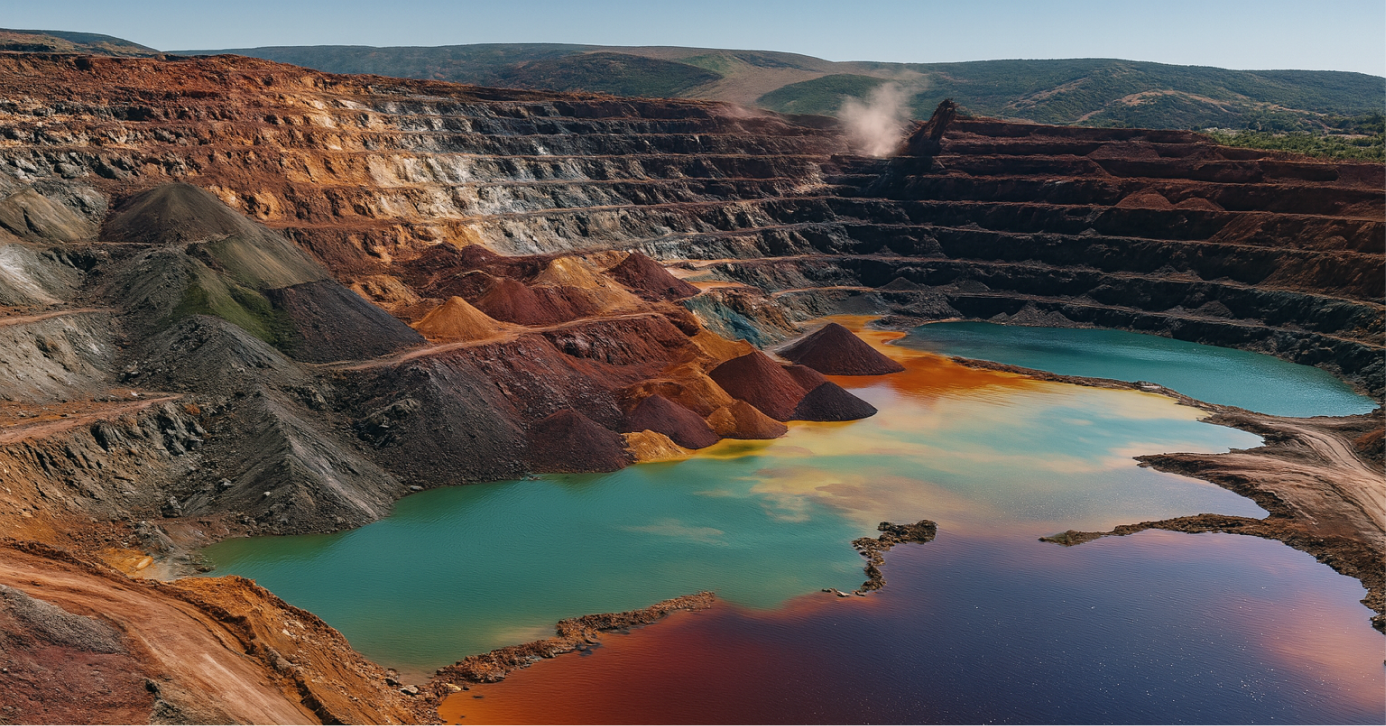
Static Liquefaction in Waste: What Has Changed From 2020 to 2025

Why static liquefaction remains at the center of the debate.
Between 2020 and 2025, static liquefaction ceased to be a concern restricted to dam stability specialists and became one of the main vectors of corporate risk in mining. Recent failures, the evolution of global governance guidelines for containment structures, and increasing pressure from investors, insurers, and regulators have pushed the issue to the level of boards and risk committees.
The central issue is no longer whether liquefaction is relevant, but rather assessing the depth to which each operation can identify susceptible structures, quantify exposure in terms of probability and consequence, and, above all, transform that diagnosis into tangible design, operation, and decommissioning decisions.
In this context, the gap between "talking about liquefaction" and actually assessing it has become more evident. Reports mentioning the risk have multiplied, but they are still based on simplified correlations, few advanced analyses, and almost no structured reflection on stress trajectories, critical states, fragility, and realistic triggers. The result is a paradox: more documentation is produced, but without a corresponding improvement in the quality of decision-making.
Recent conceptual advances
Critical state, trajectory of tensions and progressive failure.
The main conceptual shift during this period lies in the structural consolidation of the critical state as a reference point for interpreting liquefaction in tailings, combined with the consistent use of stress paths and a clearer view of progressive failures.
The starting point is no longer a single undrained shear strength value, taken as representative, but becomes the position of the material's initial state relative to the critical state line. This position, expressed in terms of relative density, void ratio, and effective stresses, determines whether the response tends to be contractile and potentially liquefiable, or whether dilatant behavior prevails, with a greater capacity to dissipate energy without abrupt loss of strength.
The stress path, represented in p–q space, is no longer treated as an academic detail, but as a practical tool. Seemingly modest changes in water level, slope geometry, or local loading can shift the operating point to regions of instability, even in materials that, at first glance, present satisfactory safety factors in conventional analyses. Ignoring this path and looking only at initial and final states means losing precisely the most relevant information about the collapse process.
Furthermore, there is a growing understanding that many ruptures follow a progressive failure pattern. The loss of rigidity and resistance begins in restricted zones, associated with depositional heterogeneities, anisotropy, or unfavorable drainage conditions. From there, stresses are redistributed, new zones enter a critical regime, and the system transitions through a sequence of metastable states until global collapse. Models that are unable to reproduce, even in a simplified way, this chain of events tend to underestimate the real vulnerability.
What post-rupture retrospective analyses have shown
Retrospective analyses conducted after recent ruptures converge on some patterns that can no longer be ignored. In several cases, the identified triggers were gradual changes in hydraulic conditions, local support cuts, modifications to drainage systems, or operational overloads of small magnitude when viewed in isolation. However, these triggers affected materials in an initial state already close to instability, with fragile structures and limited capacity to dissipate pore pressure.
Another recurring element is the role of thin, poorly draining layers, zones with loose structure, or poorly characterized transitions between different types of tailings. These discontinuities act as planes of weakness, concentrating deformation and pore pressure and creating conditions for the triggering of localized liquefaction mechanisms, which then propagate.
Finally, retrospective analysis of monitoring data revealed, in many cases, early signs of approaching instability, such as small deformations, differential settlements, changes in piezometric patterns, and changes in lake behavior. The problem was not the absence of data, but rather the lack of a conceptual model that would allow interpreting them as part of a static liquefaction failure trajectory.
Implications for geotechnical characterization
Why SPT and conventional indices are no longer sufficient.
From this new conceptual framework, it becomes clear that tests such as SPT, particle size distribution, Atterberg limits, and some conventional laboratory tests remain important, but not as the primary basis for judging susceptibility to liquefaction in tailings. These indicators provide a rough snapshot of strength and plasticity, but do not capture the combination of structure, stress path, anisotropy, and heterogeneity that governs instability.
SPT, in particular, presents structural limitations in fine, stratified, or distortion-sensitive materials. N-liq correlations originally developed for clean sands with relatively simple stress fields are not directly transferable to tailings with high fine fractions, different deposition regimes, and unconventional loading histories. When these methods are used directly, without recalibration and cross-checking, the risk of erroneous conclusions is high.
In practical terms, reports that claim low susceptibility to liquefaction based on N-SPT, average indices, and few drained or undrained shear tests no longer meet current technical and regulatory expectations. At a minimum, they raise questions from independent peers, insurance companies, and regulatory bodies.
The new “hard core” of trials
A contemporary approach, consistent with the level of risk involved and the complexity of tailings, organizes the investigation around a core of specialized tests. The CPTu, alone or in combination with seismic tests, provides continuous profiles of tip resistance, lateral friction, and pore pressure, allowing inferences of stress state, stiffness, and state parameters, as well as feeding empirical methods for liquefaction assessment.
Advanced triaxial tests, conducted in monotonic and cyclic regimes, with stress path control and pore pressure measurement, become essential to define the critical state line, map the instability line, and quantify brittleness, dilatancy, and sensitivity to different loading paths.
Instrumented CRS and oedometer tests, in turn, are indispensable for describing the relationship between stress variations and volumetric deformations, allowing the study of saturation collapse, pore pressure evolution, and consolidation times in loading and unloading scenarios. In cases where anisotropy and scale effects are relevant, tests such as DSS, bender elements, and larger specimens complement the picture.
The issue is one of focus, not quantity. Instead of extensive and poorly targeted programs, contemporary logic favors research campaigns that clearly answer the central question: "This material, in this condition of tension and history of deposition, is susceptible to liquefaction under which realistic triggers?"
History of deposition and loading as central data.
A robust geotechnical characterization necessarily involves a reconstruction of the structure's deposition and loading history. This includes the chronology of embankments and deposition campaigns, changes in particle size distribution and fines content over time, alterations to drainage systems, periods with higher lake levels or poor hydraulic control, and local interventions such as cuts, berms, partial reinforcements, and conversions of construction methods.
This historical data, when integrated with laboratory and field test data, allows each zone of the structure to be positioned within a specific time-space. In other words, it doesn't just look at "what the material is," but at "how it got here and what might happen if certain conditions change." It is this dynamic view that differentiates the typical characterization of natural soils from the appropriate characterization for tailings in high-risk structures.
Assessment methods: what works in practice
Three levels of depth that reinforce each other.
In practice, static liquefaction assessment tools can be organized into three levels of depth, which are not mutually exclusive but rather reinforce each other.
The first level is empirical and probabilistic. Methods based on CPTu, state parameters, and databases of failure and non-failure cases allow for the estimation, with uncertainty ranges, of the susceptibility to liquefaction of different zones. These methods are particularly useful for initial mapping and prioritization of areas requiring greater attention, provided that the correlations used are compatible with the type of material and the stress context.
The second level is analytical and simplified. Limit equilibrium analyses, conducted with mobilized resistance in undrained or post-peak conditions, make it possible to investigate global and local stability under representative trigger scenarios. Even without capturing all the behavioral details, these analyses provide valuable information on safety margins, critical zones, and sensitivity to parameter variations, in addition to being more transparent for audit and communication purposes.
The third level is numerical and advanced. Critical state constitutive models, implemented in code capable of simulating flow-strain coupling, allow the exploration of complex trigger scenarios, progressive failures, and three-dimensional effects, provided they are calibrated based on high-quality laboratory tests. These models should not be seen as "oracles," but as virtual laboratories where hypotheses can be tested, always with cross-checks against simpler methods, monitoring data, and field evidence.
How to avoid the trap of false accuracy.
The most obvious risk, in a scenario of increasingly sophisticated tools, is confusing model complexity with an automatic increase in reliability. Some typical signs of false accuracy include presenting safety factors or failure probabilities with several decimal places without proportional discussion of uncertainties, choosing convenient but operationally implausible loading scenarios, and the absence of systematic comparison between numerical results, empirical methods, performance history, and monitoring.
A mature practice explicitly acknowledges the limitations of available data, distinguishes between dominant and secondary uncertainty, and adopts the principle that different models, fed by coherent data sets, should converge on similar qualitative messages. When this does not occur, the focus shifts from "which model is right" to "what hypotheses are being made and what data is missing to resolve the discrepancy." This change in approach reduces the possibility of decisions based on illusory numerical comfort.
From assessment to risk management
Putting liquefaction into the language of corporate risk.
The evolution of norms, sectoral standards, and stakeholder expectations between 2020 and 2025 makes it clear that static liquefaction is a topic that needs to appear explicitly in corporate risk matrices. This means that the result of a study should not be limited to presenting safety factors or generic conclusions about the presence or absence of risk, but should translate these findings in terms of risk level, position in relation to acceptability criteria, and implications for capital, operation, and decommissioning schedule decisions.
A study aligned with current best practices clearly answers questions such as: what is the probability range associated with liquefaction scenarios under plausible triggers, what are the physical, environmental, social, and reputational consequences of these scenarios, how do these levels compare to the organization's risk criteria, what structural and non-structural mitigation measures are available, and what is the cost-benefit ratio of each alternative.
Risk language ceases to be an appendix and becomes a central part of the technical narrative, which strengthens the dialogue between engineering, risk management, senior leadership, and external stakeholders.
5.2. Decisions derived from a robust liquefaction study
When the assessment is technically sound and integrated with risk logic, it ceases to be an archived document and begins to guide concrete decisions. Among these, the following stand out: the redefinition of deposition strategies, with changes in discharge zones, operational lake limits and safety envelopes; the prioritization of reinforcement and drainage projects based on their real capacity to reduce the probability of liquefaction or to mitigate consequences; and the revision of consequence classes and assumptions adopted in emergency action plans, aligning them with the dominant failure modes.
In extreme cases, well-founded studies support decisions to anticipate decommissioning, accelerate conversions of construction methods, or suspend operations in structures where the risk of liquefaction is incompatible with the organization's risk appetite. In all these cases, the quality of the technical assessment directly conditions the robustness of the decision and the ability to defend it before regulators, communities, and investors.
Minimum checklist to avoid major mistakes.
In 2025, an operation dealing with potentially liquefiable tailings needs, at a minimum, to meet certain structural requirements. A robust conceptual model of the structure is necessary, describing geometry, raising history, drainage systems, zones of different materials, and critical interventions over time. An investigation focused on liquefaction is indispensable, including CPTu in critical regions, quality sampling, and laboratory tests aimed at defining the critical state, instability line, and fragility parameters.
A structured susceptibility assessment is also required, supported by methods that use state parameters, explicitly identifying uncertainties and more sensitive zones, as well as a mapping of plausible triggers that considers hydraulic changes, slope interventions, operational changes, and local loads. Integration with monitoring is another pillar, with plans designed to detect relevant signs of liquefaction, such as discrete deformations, pore pressure variations, and lake behavior, associated with clear warning criteria and action triggers.
Finally, it is essential that the issue be integrated into risk governance, with formal documentation in matrices, linkage to high-level decisions and, for structures with greater consequences, independent reviews conducted by external peers. In the absence of a significant portion of these elements, any statement that "the risk of liquefaction is under control" tends to be, at the very least, weak.
How does VinQ position itself in this context?
In this scenario of greater technical rigor, increased external scrutiny, and higher potential costs of inaccurate decisions, VinQ positions itself as a strategic partner to transform the static liquefaction of a defensive theme into a structuring axis of risk management.
The process begins with a critical review of existing studies, evaluating the coherence between data, models, hypotheses, and conclusions, identifying gaps that weaken the diagnosis, and proposing pragmatic routes to strengthen the analysis without necessarily increasing costs. Following this, VinQ supports the definition of research plans focused on liquefaction, choosing field and laboratory techniques that truly reduce relevant uncertainties, prioritizing zones and depths based on risk, and not just geometric criteria.
For suspicious or high-consequence structures, VinQ conducts dedicated studies that combine empirical methods, simplified analyses, and critical numerical modeling, always within the limits of available data and with consistent cross-checks. Deliverables are presented in risk language, with hierarchical mitigation alternatives, defined implementation horizons, and explicit integration with governance processes, emergency plans, and capital decisions.
Additionally, VinQ facilitates dialogue between engineering, operations, risk, and leadership through internal workshops, in which concepts of static liquefaction, critical state, failure modes, and acceptability criteria are discussed based on concrete cases from the operation itself.
If your organization suspects a risk of liquefaction but lacks a clear and actionable framework, VinQ can help build that framework, quantify the level of exposure, and structure an objective action plan that reduces risk, increases predictability, and strengthens stakeholder confidence in decisions made around the most critical structures.
Authors:

John Paul dos Santos
Bachelor in Mining Engineering (UFMG), Master in Civil Engineering and Management (University of Glasgow), Specialist in Geotechnical Engineering and Project Management.
Mining Engineer specializing in geotechnics and project management, an international reference in dams and geotechnical structures applied to mining.

Matheus Vicentini
Civil Engineer (Unilavras), Specialist in Geotechnical Engineering (PUC Minas).
Civil Engineer with experience in geotechnics applied to mining, with experience in projects, audits and dam decommissioning works.
 English
  Português do Brasil