
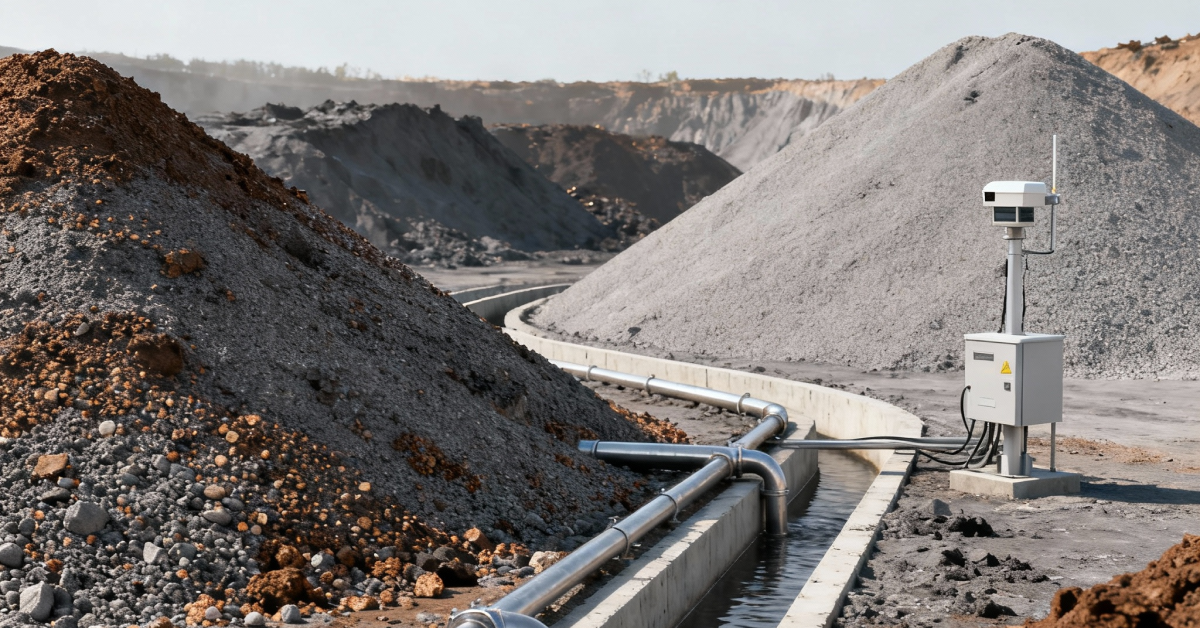
Drainage in Waste Rock and Tailings Piles: Technical Applicability and Anomaly Prevention

In waste rock and tailings piles, water is one of the main factors that contribute to geotechnical risk. When there is no efficient drainage, processes arise that directly compromise stability: increased pore pressures, surface and internal erosion, loss of strength, and progressive slope deformations. These effects not only alter the designed geometry but also reduce the structure's service life and increase the risk of partial or widespread failures.
Therefore, drainage should be understood as a central element of preventive engineering. By controlling surface runoff and internal percolation, it:
- Reduces the possibility of liquefaction and instability;
- Preserves the designed geometry, even under extreme rain events;
- Minimizes surface erosion, preventing the development of ravines and erosion;
- Extends the durability and operational reliability of the structure.
Systems Applicable to Waste Rock and Tailings Piles
Drainage should be viewed as a preventative engineering tool. In massive structures, small points of water accumulation may seem harmless in the short term, but over time, they lead to a progressive deterioration process: localized saturation, fines transport, formation of erosion grooves, and, in more critical cases, slope instability.
In the field, it's common to see anomalies that aren't corrected in time compound: silted channels reduce useful flow, surface grooves develop into ravines, and blocked drains increase hydraulic gradients. This accumulation of failures compromises the integrity of the pile and significantly increases correction costs.
Therefore, the drainage system must be designed and operated in such a way as to anticipate operational risks and mitigate progressive damage, functioning as a technical barrier against the accumulation of problems.
Main applicable systems
- Surface drainage: verges, gutters, conductive channels, dissipators and junction boxes.
- Internal drainage: bottom drains, horizontal, vertical and/or inclined and inverted filters (slopes).
- Sumps and containment basins.
Identification and Prevention of Anomalies
Anomalies in waste rock and tailings piles generally do not arise suddenly; they are the result of cumulative processes that, if not identified and corrected, evolve into critical situations.
Drainage plays a central role in this context, as it accounts for most of the problems visible during field inspections. Therefore, monitoring and maintaining these devices becomes the first line of defense against the development of geotechnical problems.
Main anomalies observed
- Slope erosion: They begin as small surface grooves and can evolve into deep ravines when there is no adequate control of flow and energy dissipation.
- Saturation at the base of the stack: results from inefficient or obstructed internal drains, increasing hydraulic gradients and reducing stability.
- Fines transportation: occurs when water carries lighter particles, indicating filtration failures or excessive gradients.
- Erosions and localized instability: arise when concentrated surface flows remain uncontrolled or unmaintained.
In this scenario, preventive measures must be well-established to ensure the safety of geotechnical structures. This involves a combination of systematic field inspections and periodic updates of hydrological studies.
Inspections allow for early identification of signs of degradation, such as silted channels, blocked culverts, reduced drain flow, and the appearance of surface infiltrations and surges. At the same time, they enable the development of these occurrences to be recorded, guiding immediate corrective measures and contributing to the updating of the structure's geotechnical and hydrological models.
Reviewing hydrological studies is essential to maintaining the reliability of drainage systems in the face of increasingly intense weather events. Updating IDF (Intensity–Duration–Frequency) curves and reevaluating design hydrographs ensure that channels, dissipaters, and drains are compatible with new precipitation scenarios. This prevents outdated structural design, and the pile maintains its hydraulic performance even under critical conditions.
All this information supports the Rainy Season Plan (PPC), which organizes reinforced inspections, prioritizes preventive maintenance, and defines response protocols during the rainy season. The PPC transforms technical data into practical decisions, increasing pile resilience and significantly reducing the likelihood of progressive failures.
Drainage is a key factor in preventing geotechnical anomalies in waste rock and tailings piles. When properly designed, implemented, and monitored, it prevents instability, extends the structure's lifespan, and reduces environmental and operational risks.
At VinQ Geotecnia, we treat drainage as a strategic component of stability. We integrate modeling, design, and field monitoring to ensure piles operate safely and sustainably, reducing uncertainty and preventing failures before they become emergencies.
Authors:

Matheus Vicentini
Civil Engineer (Unilavras), Specialist in Geotechnical Engineering (PUC Minas).
Civil Engineer with experience in geotechnics applied to mining, with experience in projects, audits and dam decommissioning works.

Leandro Azevedo da Silva
Bachelor in Geology (UFRRJ), Master in Mining Engineering (UFMG) and Specialist in Mineral Resources Engineering.
A geologist with nearly 20 years of experience in geotechnics, he leads technical projects at VINQ, combining innovation and safety in mining solutions.
 English
  Português do Brasil