
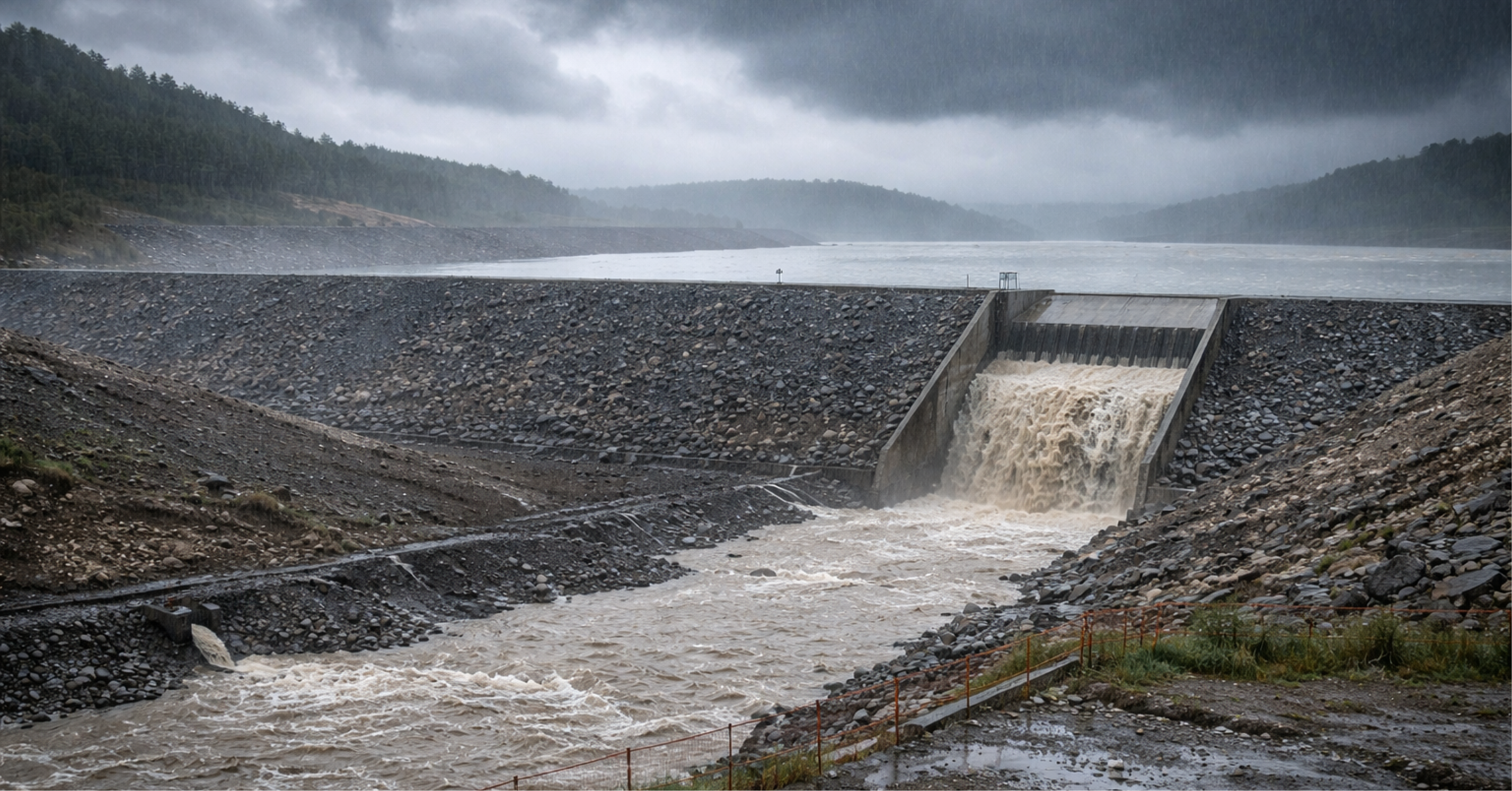
2025 – Dams and the test that governance has not yet passed.

2025 solidified a paradox that the sector already knows, but still treats as an exception: formal governance has evolved (standards, audits, committees, frameworks (and sophisticated language), however, the system's performance continued to reveal a significant gap between governance on paper and in the field. This difference becomes more visible when operations are pressured by heavy rain, operational transitions, slow degradation of barriers, and difficult decisions that compete with production, schedule, or CAPEX.
This article compiles accidents and incidents reported in 2025 and connects them to a practical diagnosis. The goal is not to "collecting tragedies...but transforming occurrences into institutional learning, based on three recurring themes:
- Water as the dominant variable;
- triggers + authority to act + potential harm to people; and,
- operational readiness.
What 2025 showed by typology
Industrial tailings and containment facilities (TSFs, storage tanks and effluent/process structures)
Method note: In many cases, the publicly available information is journalistic in nature/institutional reports. Therefore, the "technical reading" below is presented as a hypothesis consistent with the described signs, not as an expert conclusion.
1) Cambria 4 Mine (Masvingo, Zimbabwe) — 1 Jan 2025
Structure: tailings containment system (TSF/similar facility).
Reported fact: Flooding following rainfall, releasing pulp and contaminating a watercourse associated with the Shashe River.
Reported consequences: Fish mortality, impacts on animals/crops; determination of shutdown/containment and remediation measures.
Compatible technical hypothesis: Insufficient hydraulic capacity and/or freeboard control, with associated failures in channels/barriers and the transport of fines.
Governance lesson: Water management requires operational discipline with maintenance, redundancy, and a safe spillway route.
2) Illegal mining in São Domingos (Amapá, Brazil) — February 11, 2025
Structure: Dam/tailings reservoir operating illegally (without formal engineering).
Reported fact: A breach in the Igarapé Água Preta stream has caused mud/tailings to reach the Cupixi River, raising concerns about its spread to connected basins.
Reported consequences: Changes in color/turbidity, monitoring indicating heavy metals (including mercury); legal action with requests for compensation and decontamination.
Compatible technical hypothesis: Structures lacking quality control and disciplined operation tend to fail due to a combination of instability, internal erosion, and/or overtopping.
Governance lesson: Outside of an ecosystem of transparency and regulatory pressure, risk is concentrated.
3) Chambishi / Sino-Metals Leach (Copperbelt, Zambia) — February 18, 2025
Structure: Containment associated with process waste/effluents (copper).
Reported fact: Collapse/rupture with the release of acidic effluent/toxic waste into tributaries and the Kafue River.
Reported consequences: Fish mortality, damage to agriculture and significant disruptions in water intake/supply; response with neutralization (e.g., lime), health alerts and repercussions throughout the year.
Compatible technical hypothesis: Failure of critical barriers (integrity + capacity + level/percolation control + monitoring/triggers + readiness), allowing rapid evolution to a high-consequence scenario.
Governance lesson: “high downstream impact"This requires TARPs with real authority and trained response."
4) Andavilque (Potosí, Bolivia) — March 16, 2025
Structure: tailings dam/reservoir.
Reported fact: Significant instability with behavior consistent with progressive failure; public analyses discuss the possibility of static liquefaction in portions of the deposit.
Reported consequences: Downstream material flow; environmental/local damage; buried/destroyed homes and deaths/missing persons.
Compatible technical hypothesis: Saturation + loss of resistance + progressive failure, with high flow potential in a confined valley.
Governance lesson: failure modes of “flow"require governance that combines (i) geotechnical understanding (state/pore pressure), (ii) operational controls, and (iii) consequence management."
5) Iduapriem (Beposa TSF, Ghana) — early March 2025
Structure: TSF/waste installation.
Reported fact: Uncontrolled percolation from the west slope, connecting to downstream watercourses; initial measurements indicated cyanide levels above reference range.
Reported consequences: Local impacts (extent dependent on surveys and transparency of the case).
Compatible technical hypothesis: Poor percolation and internal drainage control (high water table, undersized filters/drains and/or construction conditions), with a risk of escalation to internal erosion if persistent.
Governance lesson: Recurrent percolation cannot be normalized; it needs to become a traceable action and evidence.
6) IMIP / Morowali Industrial Park – Huayue Nickel Cobalt (Indonesia) — Mar 2025
Structure: Containment measures associated with tailings in an industrial park with accelerated disposal.
Reported fact: During heavy rains/floods, a failure/breasure can cause tailings to be carried into rivers/occupied areas, resulting in community impacts.
Compatible technical hypothesis: A mismatch between disposal/raising rates, water control, and change management — a classic scenario where formal governance does not keep pace with real risk.
Governance lesson: the risk growsin the rhythm of productionWithout change management, the system becomes reactive.
7) IMIP / Morowali Industrial Park – Qing Mei Bang (QMB) New Energy Materials (Indonesia) — Mar 2025
Structure: Waste disposal facility.
Reported fact: Collapse/slippage resulting in worker fatalities.
Hypotheses reported: Weaknesses in water control/stability and preparedness for extreme events; public mention of prior instability.
Governance lesson: "Early signs" are not noise—they are data. A precursor as a trigger, not as a nuisance.
8) Quebrada Blanca (QB2, Chile) — Jul–Aug 2025 (critical incident, no confirmed rupture)
Structure: tailings dam (TSF).
Reported fact: Reports of extensive cracking and leaks, with regulatory scrutiny and questions regarding timely reporting and risk management; not described as a complete rupture.
Reported consequences: Operational pressure (production/schedule) and increased surveillance/regulation.
Compatible technical hypothesis: integrity event (crack + percolation) where the “failureThe main focus could be on governance: allowing visible degradation before halting operations based on triggers and technical authority.
Governance lesson: Near-miss experiences are the best learning asset, provided they generate structuring action, not just narrative.
Water, energy and natural structures dams (accidents/incidents reported in 2025)
9) Lutti Dam (Balrampur, Chhattisgarh, India) — September 3–4, 2025
Structure: irrigation dam.
Reported fact: Collapse/rupture, with allegations of previously reported water infiltration without preventive action.
Reported consequences: 5 confirmed deaths; search for missing persons; public debate on inspections and compliance with legislation.
Governance lesson: the problem is rarely “not knowing"; it is about not transforming information into a decision."
10) Bac Khe 1 (Lang Son, Vietnam) — October 7, 2025
Structure: small hydroelectric dam.
Reported fact: Collapse after prolonged rain; rupture in a concrete section at the water intake; detection of cracks and preventive evacuation.
Reported consequences: No casualties; damage to equipment and localized flooding.
Governance lesson: Preparedness and communication reduce consequences.
11) “Barrier Lake” (Matai'an Creek, Hualien, Taiwan) — 23–25 Sep 2025
Structure: natural dam (extreme hydrometeorological trigger).
Reported fact: Overflowing and breaching of the banks, releasing a large volume of water and debris, causing damage to infrastructure.
Reported consequences: Deaths and missing persons (numbers varied in public updates).
Governance lesson: Not all risks are assessed at the source; consequence management (alert, evacuation, routes) is part of the system.
12) Chipinge (Zimbabwe) — 2025 (farm dam)
Structure: small water dam on rural property
Reported fact: Collapse after weeks of rain.
Reported consequences: 5 children killed; damage to equipment and rural losses.
Governance lesson: “small” does not mean “low risk"when Consequence Management is high."
13) Carter Lake Dam (Polk County, Texas, USA) — November 8–9, 2025 (incident/near-rupture)
Structure: earthen dam, private property.
Reported fact: piping with an opening in the dam, triggering preventive evacuation; lowering of the water level by pumping to allow inspection.
Reported consequences: No significant flooding, but with an imminent risk considered and civil defense mobilization.
Governance lesson: Rapid response and controlled demotion are critical barriers.
14) Surreal Small Hydroelectric Plant (Tocantins, Brazil) — December 19, 2025 (partial collapse during construction)
Structure: Dam associated with power generation, in the final stages of construction.
Reported fact: Partial breach associated with the spillway; initial breach (~2 m) on the crest, with overtopping and sudden rise in the stream level downstream; intervention by the Fire Department and preventive evacuation of people/animals.
Reported consequences: Assessment of environmental damage and accountability by regulatory bodies.
Compatible technical hypothesis: Failure in hydraulic structure/level control under transient conditions (construction/commissioning), where severity depends on spill capacity, site integrity, preparedness, and communication.
Governance lesson: Transition (construction → operation) is a risk zone. Without “commissioning governanceThe system becomes vulnerable precisely when the charging regime changes.
Recurring patterns of 2025: the recurring diagnosis
- Water wins when it becomes a peripheral variable. Actual hydraulic capacity, freeboard, internal drainage, channel maintenance, response to blockages and pore pressure transients are what determine the outcome. When water is treated as a "design" issue and not an "operation" issue, governance becomes illusory.
- Triggers exist, but they don't govern decision-making. The problem is not the absence of instruments or procedures; it's the absence of TARPs (Technical Assistance Program Managers) who truly control the operation. A trigger without authority, without response time, and without a decision path is just documentation—not a barrier.
- Managing consequences comes late in the conversation. Consequence, communication, and evacuation cannot be secondary; they are critical barriers, especially in small dams, structures under construction, and facilities outside the radar of [unclear/intelligible]. disclosure.
- The shadow zone is where risk is cheap — until it becomes expensive. Where inventory is incomplete and oversight is limited, risk accumulates silently until a collapse occurs.
VinQ checklist for practical governance: what needs to exist in the field.
- Inventory and scope of responsibility: Living inventory, named owner, operational status, risk factors, and history of interventions.
- Water as an operational discipline: Operational water balance, actual capacity under extreme scenarios, structured maintenance, redundancies and safe spill routes, with periodic readiness tests.
- Actionable TARPs and real authority: Triggers linked to failure modes, instrumentation, and qualified inspection, with explicit authority to reduce/stop, downgrade levels, activate contingency plans, and escalate to executive level.
- QA/QC as traceable evidence: geometric conformity, material traceability, as built Reliable, non-conformity closure, and formal change management.
- Integrity management: cracks, seepageDeformations and drainage failures cannot be normalized; near misses need to become structural action and institutional learning.
- Exposure of people to risk and preparedness as barriers: Dynamic population mapping, communication, simulations, routes, alarms, and interface with civil defense.
The question left by 2025 (and which defines 2026)
The important question is not whether the operation “adopts a standard.” It is whether, on the worst day, with extreme rain, power outage, team change, a project in a critical phase, or pressure for production, the operation continues to be governed by evidence, triggers, and technical authority. In many cases in 2025, the answer was still “no.” The path to maturity is known; what is lacking is transforming governance into repeatable, funded, auditable operational behavior practiced in the field, every day.
If you want to reduce risk in a measurable way (and not just “complete checklistVinQ can help convert standards and documents into field routines that work under stress.
Speak with VinQ to structure, in an objective and prioritized way:
- Diagnosis of practical governance ("on paper vs. in the field"), with evidence and a plan to close gaps;
- Stress test Water management (actual hydraulic capacity, operational freeboard, maintenance and contingency);
- Actionable TARPs (triggers, authority, response times, and decision trail), integrated with failure modes;
- Integrity and preparedness program (inspections, instrumentation, change management, QA/QC and anomaly response);
- Consequence management and emergency preparedness as critical barriers (communication, drills, routes, and interface with civil defense).
Bibliographic References
- World Mine Tailings Failures (WMTF). Homepage / “State of World Mine Tailings Portfolio 2020”.worldminetailingsfailures.org)
- World Mine Tailings Failures (WMTF). “Estimate of World Tailings Portfolio 2020”. (worldminetailingsfailures.org)
- World Mine Tailings Failures (WMTF). “Status distribution w/in portfolios” (operating status and disclosure). (worldminetailingsfailures.org)
- Responsible Mining Foundation. Tailings risks: maintaining momentum (PDF, reference to WMTF and orders of magnitude).Responsible Mining Foundation – RMF)
- LinkedIn – Lindsay Newland Bowker. Profile (context and authorship/curation).LinkedIn)
- LinkedIn – Lindsay Newland Bowker. Post about TSF outage on 18/02/2025 (context Zambia/Chambishi/Musakashi).LinkedIn)
- LinkedIn – Lindsay Newland Bowker. Post “Third TSF Failure of 2025… Chambisi Copper Mine Zambia” (mentions and images/rating).LinkedIn)
- Associated Press (AP). News report on the spill/collapse and impacts at Kafue (March 15, 2025).AP News)
- Associated Press (AP). Report on allegations of underreporting and investigation (2025).AP News)
- Associated Press (AP). News report on evacuation/restrictions (US Embassy) and persistent contamination (2025).AP News)
- US Embassy Zambia. Health Alert on the collapse of the tailings dam and the risk of heavy metals (June 2025).zm.usembassy.gov)
- ISS Africa. Analysis of the Chambishi spill and its implications (May 2025).ISS Africa)
- Wikipedia. Page “2025 Sino-Metals Leach Zambia dam disaster” (as a secondary source of consolidation, with internal references).Wikipedia)
- Eos – The Landslide Blog. “A major tailings landslide at Andavilque in Bolivia” (18 March 2025). (EOS)
- Eos – The Landslide Blog. “Video of the 16 March 2025 tailings landslide at Andavilque…” (19 March 2025). (EOS)
- LinkedIn – Liam Casey. Post with a publicly available summary of impacts (as a secondary source).LinkedIn)
- Earthworks. “Multiple Dams Fail at Indonesian Nickel-Mining Facilities” (28 Mar 2025). (Earthworks)
- Business & Human Rights Resource Centre. Compilation/news report on TSF failures at IMIP and allegations of deaths (2025).Business and Human Rights Center)
- Indonesia Business Post. Article about Morowali and failures/impacts attributed to tailings facilities (Apr 2025).https://indonesiabusinesspost.com/)
- Geoengineer.org. Aggregated material on tailings crises, including IMIP (May 2025).Geoengineer)
- Reuters. News report about cracks, leaks, Sernageomin and workers' allegations (Dec 2025, citing events from Jul–Aug 2025).Reuters)
- Payne Institute/Colorado School of Mines. Reposting/curation of content from Reuters (Dec 2025).Payne Institute)
India (Lutti Dam/Balrampur, Chhattisgarh)
- The Indian Express. Breach and deaths/missing persons (Sept 2025).The Indian Express)
- SANDRP. Synthesis and analysis of the Lutti Dam case (Sept 2025).SANDRP)
- VietnamPlus (VNA). News of the collapse and evacuation (Oct 2025).Vietnam+ (VietnamPlus))
- Xinhua / Xinhuanet. News of the collapse (Oct 2025).Xinhua News)
- VietNamNet. News and context of the event (Oct 2025).VietNamNet News)
- Tuổi Trẻ News. Damage estimate and storm context (Oct 2025).Tuoi tre news)
- Al Jazeera. Typhoon coverage and barrier lake breach/overflow (September 2025).Al Jazeera)
- The Guardian (live coverage). Updates and initial casualty/evacuation figures (Sept 2025).The Guardian)
- Focus Taiwan (CNA). Follow-up article related to overflow and restrictions/impacts (Nov 2025).Focus Taiwan – CNA English News)
- CNN Brazil. Coverage of the dam breach and impacts (Nov 2025).CNN Brazil)
- CAGEPA (official website). Note on investigation and repair (Nov 2025).CAGEPA)
- Associated Press (AP). News report about collapse and deaths (March 2025).AP News)
- EnviroPress Zimbabwe. Article with local context and discussion about private dams (March 2025).enviropresszim.com)
- The Herald (Zimbabwe). Updates on victims and government response (March 2025).herald)
USA (Texas – Carter Lake Dam, near-rupture)
- KBTX. Coverage of the 8-inch hole and evacuation (Nov 2025).https://www.kbtx.com)
- ABC13. Update on level drop and evacuation lifting (Nov 2025).ABC13 Houston)
- Chron.com. Initial coverage of the alert/evacuation (Nov 2025).Chron)
- Houston Chronicle. Update on residents returning and drainage/inspection actions (Nov 2025).Houston Chronicle)
- Government of Tocantins (SECOM). Official statement describing the spillway failure and mobilization (Dec 2025).To.gov.br)
- Power360 (Power Energy). Coverage of the breach and preventive evacuation (Dec 2025).Power360)
- Brasil de Fato. Coverage of the event and performance/evaluation by the Public Prosecutor's Office (Dec 2025).Brazil in Fact)
- Tocantins Agency. Coverage of the inspection and investigation by the MPTO (Dec 2025).Tocantins Agency)
- Tocantins Newspaper. Local coverage of flooding/impacts and updates (Dec 2025).Tocantins)
- Civil Police of Tocantins (SECOM). Update on investigations/expert analysis (Dec 2025).To.gov.br)
Authors:

Leandro Azevedo da Silva
Bachelor in Geology (UFRRJ), Master in Mining Engineering (UFMG) and Specialist in Mineral Resources Engineering.
A geologist with nearly 20 years of experience in geotechnics, he leads technical projects at VINQ, combining innovation and safety in mining solutions.

Matheus Vicentini
Civil Engineer (Unilavras), Specialist in Geotechnical Engineering (PUC Minas).
Civil Engineer with experience in geotechnics applied to mining, with experience in projects, audits and dam decommissioning works.

 English
  Português do Brasil